QA Shield™
Full-package quality solution
Enterprise-grade, AI-native, QA package in 12 weeks: automation, security, performance, production monitoring and compliance-ready documentation trail. Based on 15+ years of enterprise QA. All yours, without lock-in.
The old way of QA is over.
AI writes more of your code every sprint, and it's measurably less safe. The fix isn't more testers. It's Agentic Quality Engineering.
We built a complete agentic quality system, where LLMs bring the speed, while advanced tools and highly structured processes ensure reliability. Enough of it comes prebuilt and ready to use that most projects are fully implemented in twelve weeks, at a fraction of the in-house cost, and flexible enough to plug into whatever tools and processes you already run.
We named it QA Shield. It's a distillation of years of R&D, decades of QA experience and refined over dozens of projects.
Seven things we build into your product.
QA Shield is built on seven pillars that work in synergy. In our experience all of them are needed to get the speed and efficiency benefits of AI without losing reliability, which is why we ship them together as one integral system.
Playwright automation
We prioritize reliability, driving flakiness down below 1%. Our framework is highly scalable and validates both UI + API paths. You get very fast test runs thanks to highly optimized code and parallelized execution. We standardize on Playwright over older tools like Selenium, mostly because it holds up noticeably better when tests are being drafted or maintained with AI assistance.
Spec-driven agentic workflows
AI can generate tests in seconds, but without strict constraints, agents can quickly cause chaos. We enforce an approved Markdown spec as the ground truth. Agents handle the heavy lifting, drafting test plans, generating Playwright code, and running suites, while human review gates stay mandatory. Any failure automatically triggers root-cause analysis to determine if the code broke or the spec needs updating.
Requirement and test management
Our traceability matrix is a living map of your features, it shows which requirement is covered by which test, what that test's last result was, what's the coverage for each feature etc. It sounds bureaucratic, but it's the difference between “we tested this” and “we can prove it.” We run this in our own proprietary tooling by default, but if you're already using something else, we can work inside that instead.
Performance testing, with a tool built for AI-era code
We built an in-house tracker that logs API response times over time and uses statistical and Machine Learning methods to flag anomalies and slow drifts early. We built it because of a pattern we kept noticing. AI-generated code is often correct on day one, it passes the tests, returns the right answer, but it's not optimal. This won't show up as a bug. It accumulates and shows up weeks or months later as your API getting noticeably slower under normal load, and by then it's hard to trace back to the change that caused it. Our API Response Time Analyzer catches it while it's still one commit.
Security testing
Once-a-year security audits don't work for AI-written code. 45% of AI-generated code contains at least one exploitable security weakness (Veracode, GenAI Code Security Report), often without the developer noticing, because the code looks fine and runs fine in testing. We test for the standard categories, injection, broken access control, exposed secrets, the OWASP Top 10, inside the same pipeline your code already runs through, on every release.
Real-time production monitoring
Testing before release catches what you thought to test for. Monitoring after release catches what you didn't. With AI-written code this is especially important due to the undeterministic nature of LLMs. We track error rates, latency, and failed transactions on your highest-risk flows in real time, on production. When something slips through, and eventually something always does, it's much better to find out right away from an alert, than later from a customer support ticket, a bad review or a lost client.
Compliant audit trails and documentation
Over the years, we've built a structured, high-governance workflow with minimal administrative overhead. As the work happens, every test run, requirement, and coverage decision gets logged. Quickly drafted into the right format by an LLM agent, modified and approved by a human. The result is quick and consistent documentation, thorough enough that when an auditor or an enterprise customer's security team asks for evidence, you just pull it.
Zero critical bugs, guaranteed
We're not claiming your software will never have a bug, no one can honestly promise that. What we guarantee is that the paths we've covered under the engagement, the ones we agreed are critical to your business, won't ship with a critical-severity defect on our watch.
Our Spec-Driven Agentic Workflow
An approved specification is the single source of truth: development builds from it, tests are generated from it, and a failed test either sends the code back or sends the spec back.
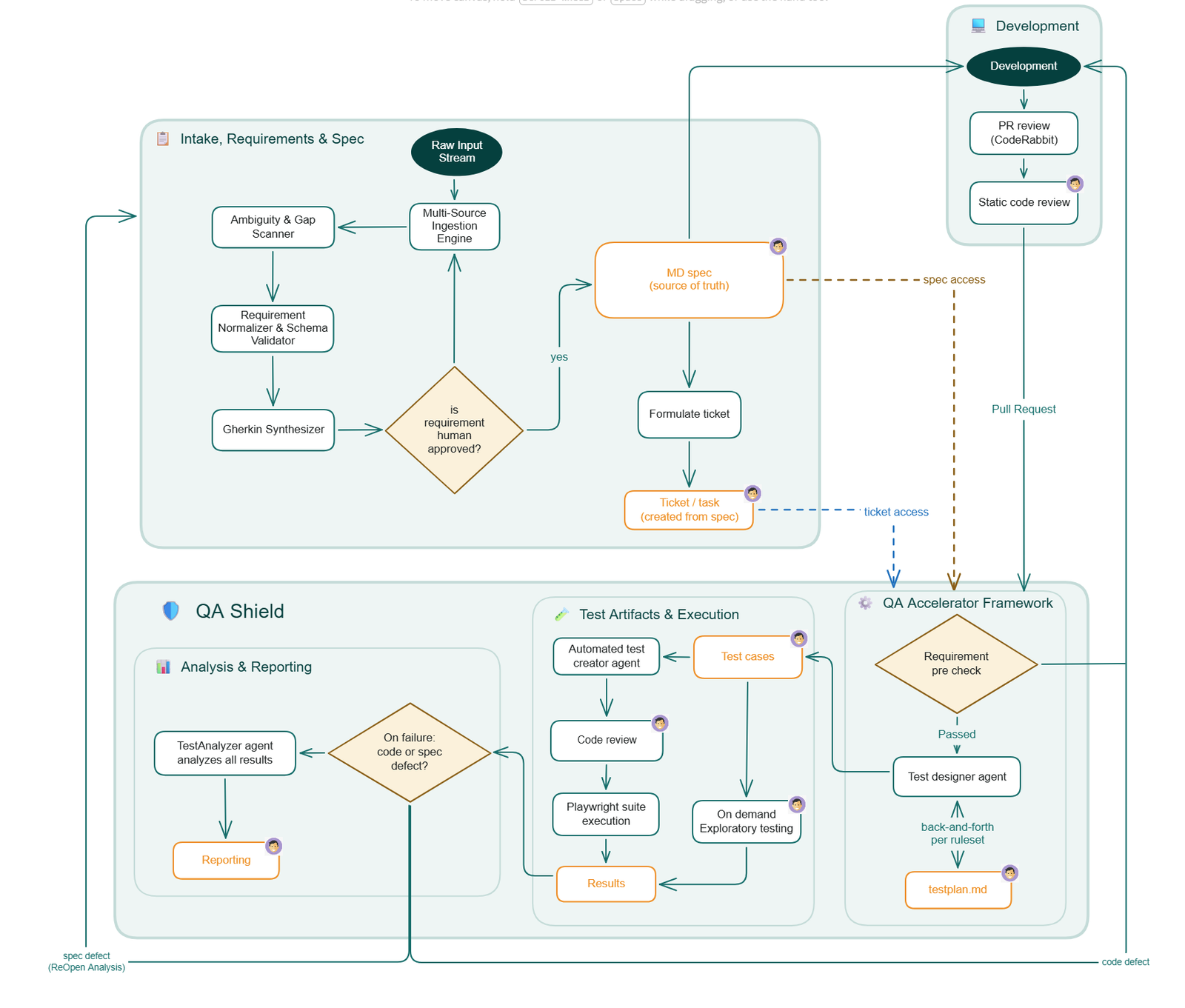
Requirement Intake & Spec Approval
Raw project inputs (like product briefs or notes) enter through an ingestion engine. The pipeline automatically scans for missing details, validates the schema, and turns requirements into Gherkin syntax (Given/When/Then scenarios). Nothing moves forward until a human approves the requirement. Once approved, the Markdown spec becomes the single “source of truth,” and development tickets are automatically generated from it.
Development & Code Review
Developers build the feature using the approved spec and tickets for reference. Automated checks, like automated pull request reviews (via CodeRabbit) and static code analysis. It runs on every change before code is merged into a Pull Request.
Test Generation & Execution
The QA phase reads directly from the approved spec and tickets:
- Pre-check & Test Planning: The system performs a requirement check against the code and generates a dynamic testplan.md.
- Test Creation: An automated agent builds executable test cases based on the plan.
- Test Runs: The system executes the automated Playwright test suite while allowing room for on-demand exploratory testing by human testers.
Failure Analysis & Feedback Loop
If tests fail, a TestAnalyzer agent steps in to triage the root cause:
- Code Defect: If the code broke, the issue loops directly back to Development to be fixed.
- Spec Defect: If the failure occurred because the original requirements were incomplete or inaccurate, it loops all the way back to Intake for re-analysis and spec updates.
What happens, and when.
Four phases, each with its own deliverable. You can stop after any one of them and still keep everything built so far.
- 01
Baseline Audit and Roadmap
1 weekWe look at what you currently have: automation coverage, defect rate, release cadence, and where the highest risk sits in your product.
You get
- A written baseline of your current QA system
- An analysis of your defect rate and where it's coming from
- A prioritized list of your highest-risk areas
- A concrete action plan for what to improve and in what order
This is a solid starting point even if you want to continue improving the system yourself. It's the blueprint for a quality system we've refined across dozens of projects, both startup and enterprise.
- 02
Pilot
3 weeksWe build full test coverage on your selected critical paths, using our Playwright automation framework, and set up the most crucial elements of the agentic workflow.
You get
- Reliable test automation on the highest-risk paths you chose
- A truly scalable agentic base framework you can build on
- A look at how we work, before you commit to more
- 03
Full QA Shield Implementation
8 weeksWe extend coverage across the rest of your product and build out the full system: spec-driven agentic workflows, performance testing, security testing, real-time production monitoring, and a full traceability matrix. We train your team to run, maintain, and extend it themselves.
You get
- At least 80% automation coverage of your product
- A spec-driven agentic workflow that can drastically speed up your quality processes without losing reliability
- Performance and security testing built into your pipeline
- Real-time production monitoring
- A traceability matrix connecting requirements to tests
- Education on how to run, maintain and extend the system, with no dependency on us
By the end of this phase, you fully own the system. No fine print, no lock-in. You can run it in-house, or keep working with us to scale it further.
- 04
Extension and Maintenance
6 months / ongoingWe keep the system alive as your product grows: new coverage as you ship new features, active maintenance on the suite, flakiness kept under 1%, and access to the internal tooling and R&D we build across our projects.
“You cannot inspect quality into a product. The quality, good or bad, is already there.”
Which is why QA Shield isn't just about testing your code. It's a quality engineering system woven into every phase of your SDLC (requirements, development, release, and production) to make sure quality gets built in from the start, not checked for at the end.
Let's cover every line your AI writes.
Tell us about your stack and release cadence, and we'll scope a baseline audit and a paid pilot on your highest-risk flow - with the numbers measured on your own dashboard.